

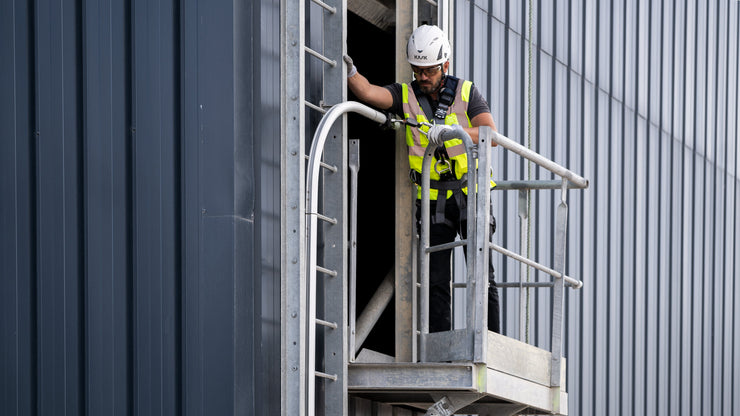
No safety system is completely foolproof. Guardrails can be damaged, anchor points can weaken over time, and skylight screens can crack under weight. Personal fall arrest systems (PFAS) exist for exactly this reason, acting as a last line of defense when primary fall protection comes up short.
This article breaks down what these systems include and how the Occupational Safety and Health Administration (OSHA) regulates them. It also covers where compliance often breaks down on the job and what facility managers can do to keep workers protected at height.
What are Personal Fall Arrest Systems?
A personal fall arrest system (PFAS) stops a worker mid-fall before contact with a lower level or surface below. Rather than a single product, PFAS functions as a complete system made up of an anchor point, a connector and a body harness. Each piece plays a specific role in keeping a fall short and controlled, and the system only works as intended when all three hold up under pressure.
Some common examples of personal fall arrest systems include:
- Fixed anchor systems. Permanent connection points installed directly into a roof structure or support beam
- Horizontal lifeline systems. A cable or rail that runs along a roof edge so workers can move while staying connected
- Self-retracting lanyards. Devices that lock automatically during a fall to limit how far a worker drops
- Vertical lifeline systems. Used mainly on fixed ladders to allow safe upward and downward movement
Choosing the right combination depends on more than the equipment itself. Matching a harness and lanyard to the worker, task and anchor point plays a large role in whether the system performs as designed. These systems sit at the center of how OSHA approaches fall protection at height. Understanding what qualifies as compliant gear is the first step toward avoiding violations during a project.
Common OSHA Violations Involving Fall Arrest Systems
Fall protection remains one of the most frequently cited safety issues on job sites across the country. Many contractors treat personal fall arrest systems as a checkbox rather than a full system, and that mindset leads to repeated compliance failures.
Below are some of the most common violations tied to fall arrest systems:
- Using outdated body belts. Some job sites still rely on belts instead of full-body harnesses, despite the ban on this practice
- Incorrect D-ring placement. Attachment points are sometimes mounted off-center or too low, reducing the effectiveness of the harness during a fall
- Excessive free fall distance. Systems that allow a worker to fall too far before arrest increase injury risk and fail to meet basic safety limits
- Skipping pre-use inspections. Workers sometimes put on gear without checking for wear, damage or deterioration
- Reusing gear after a fall. Harnesses and lanyards involved in a fall event are sometimes kept in service instead of being retired
- Weak lanyards and lifelines. Connectors that fall short of required breaking strength put the entire system at risk
These violations rarely happen in isolation. They tend to build on each other, which is why understanding OSHA regulations matters just as much as recognizing where compliance tends to break down.
OSHA Recommendations for Keeping Workers Safe at Height
OSHA outlines specific requirements for personal fall arrest systems under 29 CFR 1926.502, 29 CFR 1910.140 and 29 CFR 1926.104. Together these standards cover construction and general industry work, addressing equipment performance, inspection routines and connector strength. Meeting these requirements helps ensure a fall arrest system functions correctly when it matters most. For a closer look at what these standards mean in practice, visit our OSHA compliance FAQ.
Key recommendations from these standards include:
- Use of full-body harnesses. Body belts have been banned for fall arrest since January 1, 1998 due to the internal injury risk they pose during a fall
- Center the D-ring properly. The harness attachment point, where the lanyard or lifeline connects, must sit at the center of the back near shoulder level, or above the head, to distribute force correctly across the body
- Limit arresting force. A harness must keep the maximum force on a worker's body at or below 1,800 pounds
- Restrict free fall distance. Systems must prevent a worker from free-falling more than six feet or contacting a lower level
- Inspect gear before every use. Workers must check harnesses for mildew, wear and damage, removing any defective equipment immediately
- Retire gear after a fall. Any harness that absorbs a fall must be taken out of service permanently
- Meet lifeline strength minimums. Lanyards and lifelines must carry a minimum breaking strength of 5,000 pounds
- Schedule periodic inspections. A Competent Person, which is someone qualified to identify hazards and authorized to correct them, should conduct a documented inspection of all fall protection equipment every six to twelve months
Following these standards closely is what separates a fall arrest system that works on paper from one that performs in the field.
How Safety Rail Source® Reinforces Personal Fall Arrest
Meeting OSHA requirements starts with equipment built to perform under real conditions, not just pass on paper. A fall arrest system is only as reliable as its weakest component, which is why sourcing quality anchors, harnesses and connectors matters as much as understanding the regulations behind them. Safety Rail Source® provides OSHA-compliant equipment designed specifically for rooftop work.
Some of the core personal fall arrest products we offer include:
- NextGen Post-Type Roof Anchor™. A permanently mounted anchor point that meets or exceeds OSHA 1926 Subpart M and OSHA 1910, giving workers a reliable tie-off point on commercial roofs
- Akula Premium Safety Harness. A full-body harness with proper D-ring placement, built to distribute arresting force correctly during a fall
- Lanyards / SRLs / Anchor Straps. Connectors that meet minimum breaking strength requirements while matching the clearance and mobility needs of the task
- NextGen Fixed Ladder Lifelines. Vertical lifeline systems designed for safe, controlled movement on fixed ladders, including SecuRope™, SecuRail™, Mighty-Lite™ and NextGen Steel™ Ladders.
Each product is selected and paired based on the specific roof, task and worker involved, so the full system holds up the way it is meant to. Browse our full product catalog to find the right personal fall arrest solution for your facility.