
Maintaining safe rooftop access and elevated work areas is a major responsibility for facility managers, as falls remain one of the leading causes of workplace injuries in the United States.
Many safety programs review OSHA guardrail requirements when evaluating rooftop hazards to ensure compliance. These standards help building operators reduce fall risks and stay compliant with federal safety rules. However, many older facilities were built before modern fall protection practices became common. As a result, guardrails may be missing around roof edges skylights equipment platforms and roof access points.
A rooftop safety review can help facility managers identify these gaps and decide where guardrails should be installed.
Why OSHA Guardrail Requirements Matter for Existing Facilities
OSHA railing requirements exist to reduce the risk of falls from elevated surfaces. Workers who access rooftops, mechanical platforms or elevated walkways face serious risks when fall protection is not present.
Rooftop safety in older buildings often depends on parapet walls or temporary barriers. While these features may appear adequate, they do not always meet modern safety expectations.
Some parapet walls are too low to provide reliable fall protection. In these situations, additional guardrail systems may be needed to create a safer work environment.
Common fall hazards in existing facilities include:
- Roof edges with low parapet walls
- Skylights that create hidden fall hazards
- Roof access hatches without protective barriers
- Maintenance areas located near unprotected drop offs
- Elevated equipment platforms without permanent guardrails
For safety managers, these conditions often signal the need for permanent guardrail systems.
Understanding OSHA Guardrail Requirements
OSHA guardrail requirements define basic safety standards for elevated surfaces in general industry workplaces. These regulations apply to many types of facilities, including manufacturing plants, hospitals, schools, warehouses and commercial buildings.
Typical OSHA guardrail requirements include:
- Guardrails must be approximately 42 inches high (± 3 inches)
- Midrails must be installed between the top rail and the walking surface
- Guardrail systems must be capable of withstanding at least 200 lbs. of outward or downward force
- Open sides of elevated platforms and walkways must be protected with appropriate fall protection systems
These standards together will ensure that guardrails act as a dependable barrier between workers and dangerous drop offs. For existing facilities, installing compliant guardrails often provides a straightforward way to address rooftop hazards.
Where OSHA Guardrail Requirements Apply in Existing Facilities
Many buildings have several areas where guardrails improve worker protection. Maintenance teams often access rooftops mechanical equipment and elevated service areas.
These work zones are often located near roof edges skylights or other fall hazards. Guardrails are commonly installed around these locations to help protect maintenance personnel.
Typical installation areas include:
- Roof edges near maintenance zones
- Skylights that may be difficult to see from a distance
- Roof access hatches used during service work
- Mechanical equipment platforms
- Elevated walkways near rooftop HVAC systems
Permanent guardrails allow maintenance personnel to move safely across the roof without relying on temporary protection equipment.
Guardrail Solutions That Help Meet OSHA Guardrail Requirements
Some facility managers assume fall protection upgrades require major structural changes. Yet, many guardrail systems are designed to work with existing roof layouts.
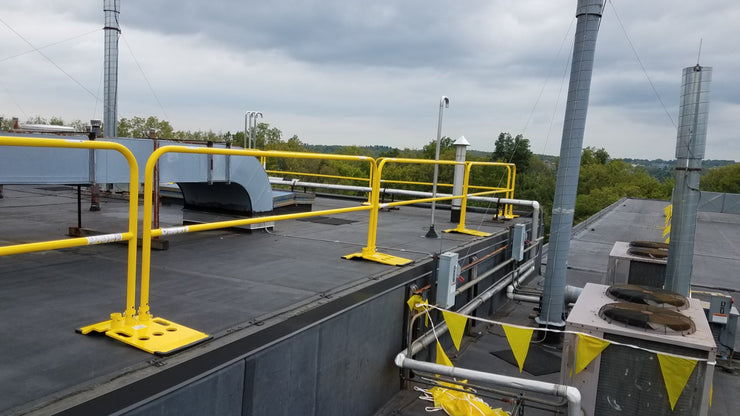
Safety Rail Source provides NextGen 3000 Universal Guardrails built to address OSHA guardrail requirements in existing buildings. These systems can often be installed without penetrating the roof membrane and protects the roof surface while improving worker safety.
Key features of NexGen 3000 Universal Guardrail include:
- OSHA compliant design that meets federal fall protection standards
- Non penetrating installation that protects roof surfaces
- Durable construction suited for long term rooftop exposure
- Modular sections that adapt to different rooftop layouts
- Compatibility with crossover stairways platforms and roof hatch systems
Facilities can strengthen rooftop protection while avoiding major building modifications with these design features.
Combining Guardrails with Safe Rooftop Access
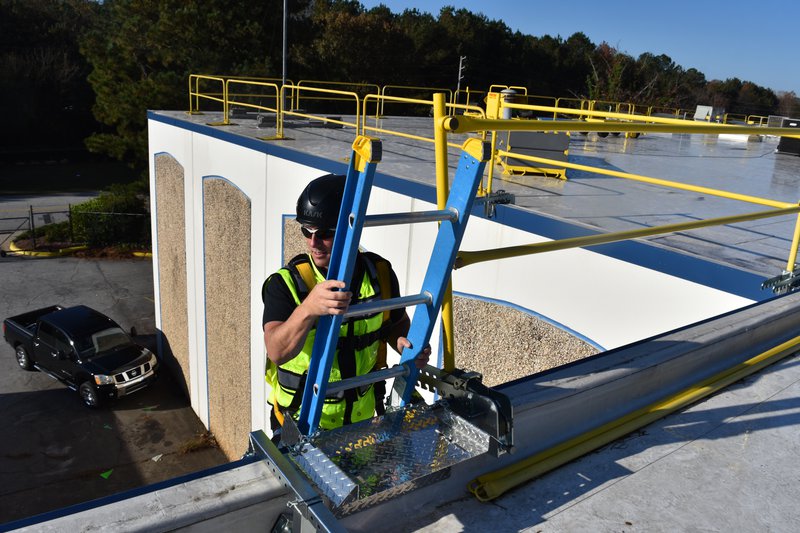
Guardrails often work best when used with other rooftop safety systems that guide maintenance personnel safely across complex roof layouts.
Safety Rail Source offers several solutions that support rooftop fall protection programs:
- NextGen Fixed Ladder for controlled rooftop access
- NextGen Lift & Lock Roof Hatch Opener for managing roof hatch entry points
- NextGen Crossover Stairways for safety and ease of traversal over rooftop obstacles
Together, these systems create safer access routes and reduce exposure to fall hazards.
Benefits of Meeting OSHA Guardrail Requirements
Meeting OSHA guardrail requirements offers several advantages for existing facilities.
Permanent guardrails reduce the risk of worker injuries from rooftop falls. They also help facilities maintain compliance during OSHA inspections.
Other advantages include:
- Safer conditions for maintenance personnel
- Permanent fall protection that does not require daily setup
- Greater confidence for safety managers and building owners
- Improved organization of rooftop access areas
Maintenance tasks often become easier and more efficient now that workers can move safely around rooftop equipment.
Strengthening Rooftop Safety in Existing Facilities
OSHA guardrail requirements provide clear guidance for protecting workers at elevated heights. For many buildings, improving fall protection begins with installing guardrails around roof edges skylights access points and elevated platforms.
Using NextGen 3000 Univeral Guardrail Systems from Safety Rail Source help facilities improve rooftop safety while supporting OSHA compliance. These systems provide long term protection that supports safe maintenance operations across commercial industrial and institutional buildings.
To learn more about improving rooftop, safety contact Safety Rail Source today for guidance and support in meeting stringent safety construction requirements.