

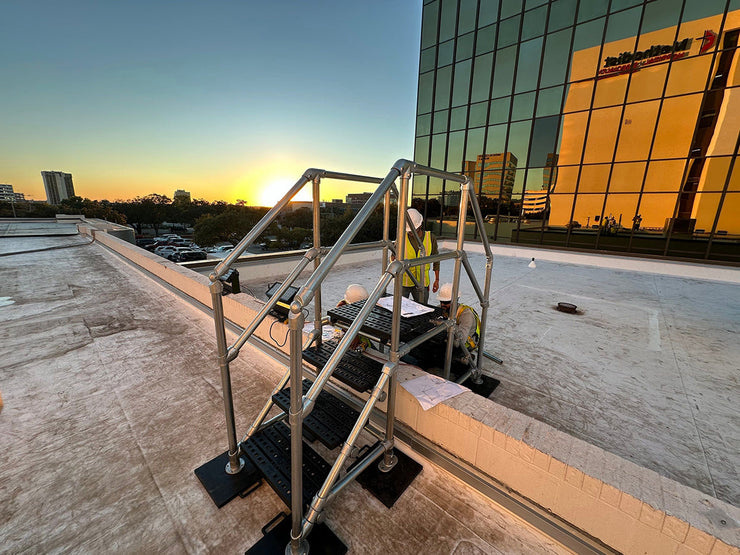
Rooftops packed with equipment, ductwork and pipe runs leave workers with no safe way to cross from one point to another. Facilities that skip a defined path force employees to step over obstacles and closer to unprotected edges. Elevated walkways solve this problem by giving workers a fixed, protected route across the roof.
The Occupational Safety and Health Administration (OSHA) sets specific requirements for how these walkways must be built and guarded. Meeting those requirements protects workers and keeps facilities out of violation. In this article, we cover what elevated walkways are, the violations they prevent and the OSHA regulations that apply to them.
What are Elevated Walkways?
Elevated walkways are raised, fixed paths that let workers move safely across a roof or other elevated surface. They typically connect two points, such as separate roof sections, mechanical units or adjoining buildings. The walkway sits above the surrounding surface, giving workers solid footing instead of an improvised route.
Here is what elevated walkways typically do and where facilities use them:
- Provide a stable, defined route across rooftop obstacles like pipes, conduit and ductwork
- Connect separate roof levels or link adjoining buildings and structures
- Guide workers around mechanical equipment such as condensers, chillers and exhaust units
- Common on industrial facilities, manufacturing plants, hospitals and schools with equipment-heavy rooftops
- Used alongside other access points like hatches and ladders, which get workers onto the roof rather than around it
A roof without a defined walkway leaves workers to find their own way past whatever is in front of them. That inconsistency is where most rooftop fall hazards start. Establishing a fixed path is the first step toward addressing the violations OSHA regulations are designed to prevent.
Compliance Violations that Elevated Walkways Prevent
Rooftop work without a defined path creates the exact conditions OSHA cites employers for. Workers end up crossing dangerous areas on their own judgment instead of a fixed, guarded route. A properly built elevated walkway removes that guesswork.
Here are the common violations a defined walkway helps prevent:
- Falls from unprotected edges. Workers who step around equipment without a marked path can drift closer to an open roof edge than they realize. A fixed walkway keeps them on a route set back from the perimeter.
- Falls onto or into rooftop equipment. Ductwork, condensers and other raised units become fall hazards when there is no clear way around them. A walkway routes workers past this equipment instead of over it.
- Falls through skylights or roof openings. Workers cutting across an unmarked roof are more likely to encounter an unguarded hole. A defined path keeps them away from those openings.
- Unsafe crossings over pipes and conduit. Stepping over raised piping without a stable surface raises the odds of a trip that turns into a fall. A walkway gives workers solid footing instead.
- Inconsistent access routes. Without a set path, different workers and contractors may cross the same roof in different ways. That makes the hazard harder to track and inspect.
Each of these violations carries real financial risk on top of the safety risk. OSHA penalties for fall protection violations can run into the tens of thousands of dollars per instance, and repeat citations compound quickly. A fixed elevated walkway addresses several of these exposures at once, rather than requiring a separate fix for each one.
Core OSHA Standards for Elevated Walkways
Elevated walkways fall under OSHA's walking-working surfaces standard, which regulates how any raised path on a roof or elevated area must be built and guarded. OSHA has specific requirements under 29 CFR 1910.28(b)(5) that govern when a walkway needs a guardrail system and how that system must perform to protect workers from falls. Building and facility managers can visit our OSHA compliance FAQ for more context on how these requirements apply on-site.
The core requirements include:
- Guardrails on runways and similar walkways. Employers must protect workers from falling four feet or more with a guardrail system. If a guardrail is not feasible on both sides, OSHA allows one side to go without it only if workers use a personal fall arrest or travel restraint system.
- Guardrail height and strength. Top rails must sit 42 inches above the walking surface, plus or minus 3 inches. The rail must withstand at least 200 pounds of force without dropping below 39 inches.
- Midrail and opening limits. Midrails must withstand at least 150 pounds of force. Openings between vertical members cannot exceed 19 inches.
- Hole and skylight protection. Any hole or skylight along a walkway route must be covered or guarded. This applies even if the opening sits just off the main path.
A walkway that clears the height and load requirements can still fail inspection if a nearby skylight goes unguarded. Facility managers need to check the full route against each of these codes, not just the guardrail itself. That full-route review is what determines whether a walkway passes or draws a citation.
Elevated Walkways that Safety Rail Source® Provides
Meeting these OSHA standards often comes down to the products installed on the roof. Safety Rail Source® (SRS) designs and manufactures crossover solutions built for the obstacles and level changes found on most commercial and industrial rooftops. A few examples of which include:
- Erectastep® Crossover Stairways and Platforms. This line uses modular components that bolt together to fit nearly any roof layout, with no welding or custom fabrication needed. Components ship ready to assemble, and facilities with an immediate need can pull from in-stock inventory rather than waiting on a custom build.
- NextGen Crossover Stairways and Platforms™. These are custom built to the dimensions of the specific hazard or platform a facility needs to cross. SRS designs each one based on measurements and photos submitted from the site.
- NextGen Skylight Safety-Screens™. If a walkway route passes near a skylight, these screens cover the opening and address OSHA's hole protection requirement. Workers can stay on the main path without needing to reroute around the hazard.
Each of these products addresses a different part of the walkway, from the crossing itself to the edges and openings around it. Facility managers can mix and match based on what a specific roof requires. Explore our full product catalog to see the complete range of safety solutions SRS offers.