

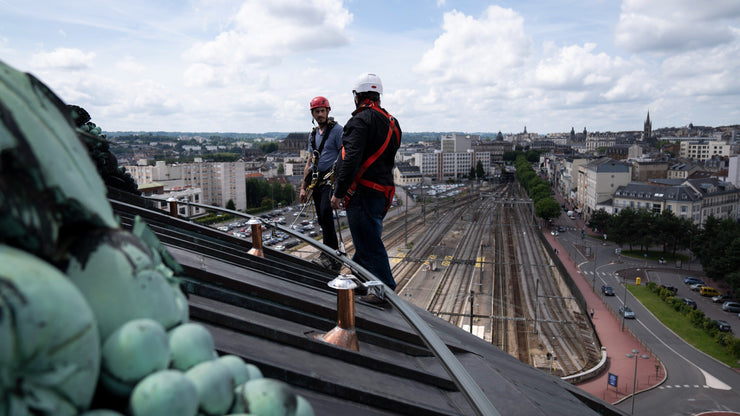
Not every roof allows for a straightforward guardrail installation. Steep pitches, tight clearances and heavy load requirements often rule out a passive barrier altogether. Custom fall arrest systems give workers an engineered way to stay protected when a standard setup will not do.
Knowing how these systems work matters before any installation begins. This article breaks down what custom fall arrest systems are, the violations they help prevent and the OSHA regulations that guide their design. It also covers the solutions available for facilities that need this level of protection.
What are Custom Fall Arrest Systems?
Custom fall arrest systems combine engineering and active fall protection to match a facility's specific layout, height and access needs. Unlike prefabricated fall arrest kits, custom systems take shape only after an evaluation of a roof's pitch, clearance and structural layout. Every component fits the site instead of a generic size.
These systems play a bigger role than meeting a checklist requirement. They give facility managers a way to close safety gaps that generic fall protection accessories cannot fully address, especially in areas workers access often. That role becomes clearer when looking at how these systems are actually built and used on site.
For instance, here are some examples of custom fall arrest systems:
- Horizontal and inclined lifeline systems. Installed across roof decks, warehouses, bridges and aircraft hangars as cable-based or rigid rail configurations. Workers move along a trolley or track without disconnecting between anchor points.
- Vertical lifeline systems. Used on fixed ladders taller than 20 feet. A harness connects to a traveling sleeve on a cable or track, arresting a fall the moment a worker slips.
- Facade and suspended access systems. Built for multi-story buildings needing exterior maintenance. These rely on dedicated anchor points, building maintenance unit (BMU) designs and suspension hardware to support workers scaling the exterior safely.
Compliance Violations that Custom Fall Arrest Systems Prevent
Fall protection has topped the list of most frequently cited safety standards for 15 straight years, according to the National Safety Council. Facilities that rely on generic equipment or skip an engineered evaluation often end up out of compliance without realizing it. Custom fall arrest systems close that gap by matching protection to the actual hazard instead of a one-size-fits-all setup.
Getting this wrong rarely comes down to one big mistake. It usually shows up as a handful of smaller gaps that compound over time and turn into serious violations during an inspection. These are the most common compliance issues facilities run into:
- Missing protection on steep or irregular roofs. Standard guardrails do not fit every roofline, and skipping a custom solution leaves these areas exposed.
- Underrated anchorage points. Anchors that cannot support the required load per worker put the entire system at risk.
- Improper rigging distances. Lifelines set up without accounting for fall clearance or deceleration space increase injury risk.
- Unsupervised installations. Systems installed or modified without a qualified person overseeing the work often miss critical safety margins.
- Ladder access without vertical protection. Fixed ladders left without a lifeline system expose workers on long climbs.
Each of these gaps points to the same issue. Fall protection only works when it accounts for the site it is protecting.
Core OSHA Standards for Fall Arrest Systems
Custom fall arrest systems fall under the Occupational Safety and Health Administration (OSHA) standards 29 CFR 1910.140 and 29 CFR 1910.28. Together, these sections define how personal fall protection equipment must be designed, rigged and used on a job site. Meeting them is what separates a compliant setup from one that only looks compliant. Facility managers looking for more detail on these requirements can find it in our OSHA compliance FAQ.
Each standard addresses a different part of how a fall arrest system functions once installed. The list below breaks down what they require in practice.
- Qualified oversight. A qualified person must design, install and oversee every system from start to finish.
- Anchorage strength. Anchorage points must maintain a safety factor of at least two, or support at least 5,000 pounds per attached worker.
- Arresting force limits. A worker's body cannot experience more than 1,800 pounds of force when the system arrests a fall.
- Deceleration distance. Systems must bring a falling worker to a stop within 3.5 feet to limit injury.
- Free fall limits. Rigging must prevent a worker from free falling more than 6 feet or contacting a lower level.
- Ladder and edge protection. Fixed ladders over 20 feet require vertical lifelines, and workers within 6 feet of an unprotected roof edge need active protection.
A custom fall arrest system earns its name by engineering around every one of these thresholds at once. That level of precision is what keeps workers protected on the roofs standard equipment cannot handle.
Custom Fall Arrest Systems that Safety Rail Source® Provides
Safety Rail Source® (SRS) designs, engineers and installs custom fall arrest systems built around each facility's roof and access points. Every system SRS builds is engineered to meet the OSHA standards outlined above while keeping a low profile that preserves the roofline.
- NextGen SecuRail™ Horizontal Lifeline. A rigid rail system for roofs with minimal fall clearance, giving workers continuous tie-off along the track.
- NextGen SecuRope™ Horizontal Lifeline. A cable-based lifeline available for hot deck, cold deck and standing seam roofs, letting workers move freely via a trolley.
- NextGen Overhead Suspended Lifelines. Built to span long distances overhead, suited for loading areas and large industrial facilities.
- NextGen MastLadder™ with SecuRail™ Vertical Lifeline. Vertical protection for fixed ladders, keeping workers connected from base to top.
While the systems above cover some of the most demanding rooftop and access scenarios, they represent only part of SRS's full lineup of safety solutions. We supply guardrails, hatch protection, skylight screens and anchor points designed to address different OSHA compliance challenges across a single facility.
Engineered fall arrest is just one layer of a complete safety plan. To find the right combination for your site, explore our full product line at SRS and connect with our team to start the design process.