

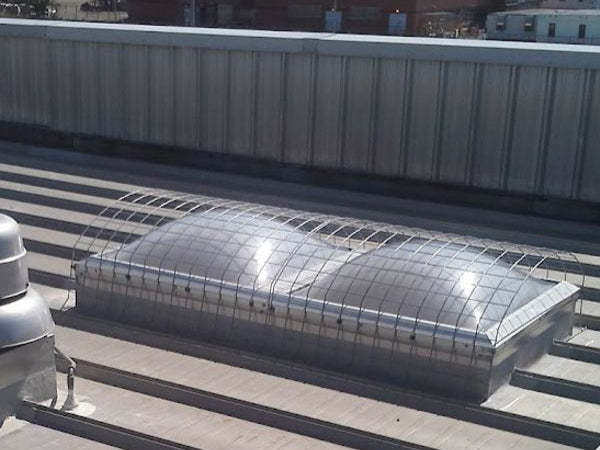
Skylight fall protection is one of the most important safety considerations for school facility managers, yet skylights remain of the many hazards on school rooftops. Most school buildings have skylights on gymnasiums, cafeterias and classroom wings. Because maintenance staff access school rooftops regularly for HVAC service, inspections and repairs, keeping these areas safe and secure is essential.
OSHA treats every skylight as an opening in the roof surface, regardless of whether it has a dome or glazing in place. This means schools are responsible for protecting workers any time someone goes on the roof. Unprotected skylights are a compliance issue and a serious injury risk that facility managers cannot afford to leave unaddressed.
Why skylights are a serious fall hazard in school facilities
Most skylights are not built to support the weight of a person. A worker who trips, loses footing or backs into a skylight dome can fall through it with little warning. Acrylic and polycarbonate domes may look sturdy, but they weaken over time from sun exposure, temperature changes and weathering. A dome that held up years ago may not hold up today.
School rooftops add another layer of risk. Maintenance crews often work around multiple rooftop units, vents and drains in a confined space. Skylights can sit close to equipment service paths, putting workers near them more often than they may realize. According to the Bureau of Labor Statistics, falls accounted for 82 percent of roofing fatalities in 2023, a number that reflects how often routine rooftop work puts people near unguarded hazards like skylights.
Skylight fall protection requirements schools need to meet
OSHA classifies skylights as holes in the walking-working surface. Any skylight 4 feet or more above a lower level must have fall protection in place. That protection must take one of four forms: a cover, a guardrail system, a travel restraint system or a personal fall arrest system. Facility managers can review the full details on unprotected skylights to understand exactly what OSHA requires for each protection type.
Skylight Screens vs. Guardrails: Choosing the Right Solution
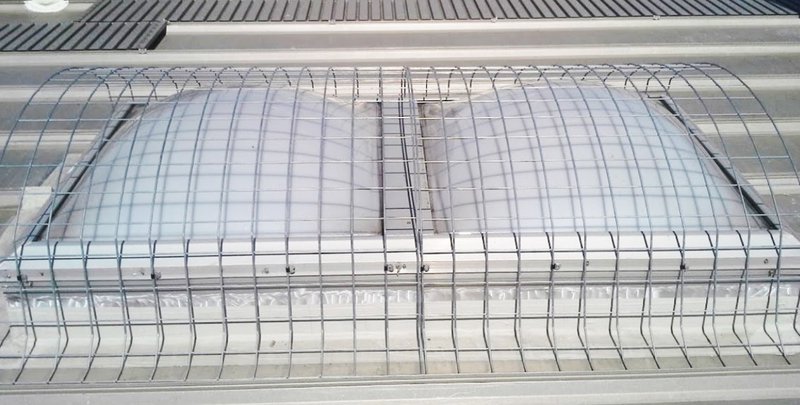
Two passive solutions handle most rooftop skylight situations: screens and guardrails. Both keep workers from falling through a skylight without requiring personal protective equipment or special training to be effective.
Skylight screens install directly over the dome and must support at least 200 pounds of force without failure. They are a good fit for skylights in open areas where a guardrail would be difficult to route around equipment or other obstacles. Guardrail systems surround the skylight perimeter and meet OSHA height and strength requirements. They work well for larger skylights or areas where workers regularly pass nearby. For schools looking for a passive, non-penetrating option, NextGen Skylight Screens™ are one example of a compliant skylight fall protection designed for commercial and institutional rooftops that protects workers without penetrating the roof membrane.
The right choice depends on skylight size, location and how often workers access that area of the roof.
Roof Hatches and Access Points Near Skylights
Roof hatch placement matters when skylights are nearby. A worker who exits a hatch and steps onto the roof without a clear view of the layout can move toward a skylight before realizing the hazard. Schools with hatches near skylight clusters need to account for that transition in their fall protection plan.
Hatch railings help control the path workers take when they first step onto the roof. A compliant hatch railing keeps workers inside a protected zone while they get their bearings and move toward the work area. One compliant option for schools is KeeHatch® Roof Hatch Railing, an OSHA-compliant system designed for unprotected roof hatches that manages safe egress and ingress through roof access points.
Pairing hatch protection with skylight screens or guardrails gives schools a more complete approach to rooftop safety.
How Schools Can Plan a Rooftop Skylight Safety Review
A skylight safety review does not need to cover the entire building at once. Facility managers can start with the rooftop areas that maintenance staff access most often and work outward from there. The goal is to identify every skylight, confirm its current protection status and determine what needs to change before the next maintenance visit.
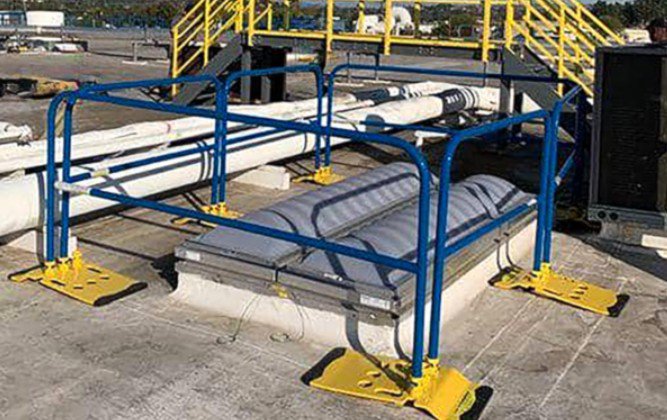
Key steps in a rooftop skylight review include:
- Mapping every skylight. Walk the roof and record the location, size and condition of each skylight. Note which ones sit near equipment service paths or hatch access points.
- Checking current protection. Confirm whether each skylight has a compliant screen, guardrail or other OSHA-approved protection in place. A dome alone does not count.
- Assessing conditions. Look for cracked, discolored or aging glazing. Older domes are more likely to fail under load.
- Reviewing access routes. Check whether workers pass near skylights when moving between the hatch and rooftop equipment.
- Record Keeping. Record what was checked, what needs attention and what steps the facility plans to take.
School facilities also face unique access and security challenges beyond skylights, including rooftop safety concerns that extend to unauthorized access and building security.
Skylight fall protection options for school facility managers
Schools have several practical options for bringing skylights into compliance. Passive systems like screens and guardrails are the most straightforward because they protect workers without requiring any action on the worker's part. They are always in place and do not rely on proper equipment use or training to function.
For schools with a large number of skylights or complex roof layouts, a combination of solutions may be the most effective approach. Screens work well for smaller or isolated skylights, while guardrail systems suit larger openings or high-traffic areas. Safety Rail Source covers a wide variety of skylight screens and skylight railing for the safety needs of school rooftops.
Request for an expert OSHA Code Assessment from Safety Rail Source today to identify compliance gaps across the full rooftop, including skylights, hatches and roof edges, before a maintenance visit creates a problem.