

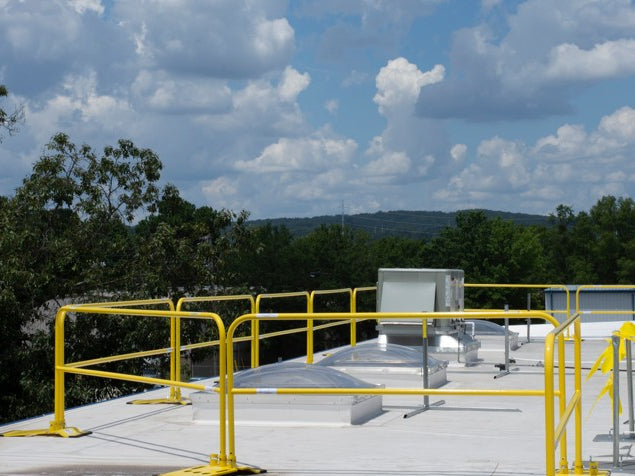
Understanding OSHA roofing standards is an important part of managing a safe commercial facility. Whether workers are performing routine maintenance, accessing rooftop equipment, inspecting building systems or completing repairs, facility managers are responsible for ensuring appropriate fall protection measures are in place. Failing to comply with applicable OSHA requirements can increase the risk of serious injuries and liability.
Not all rooftop activities are governed by the same standard. OSHA requirements can vary based on the type of work being performed, who is performing it and the conditions present on the roof. This guide reviews the OSHA roofing standards facility managers should know, including requirements for roof edges, skylights, roof hatches, fixed ladders and rooftop access.
General Industry vs. Construction: Which OSHA Standard Applies
Two separate OSHA standards cover rooftop fall protection. The general industry standard applies to facility maintenance work, such as HVAC servicing, roof inspections and routine repairs performed by building staff or their contractors. The construction standard applies when a crew is replacing a roof, installing new systems or doing structural work.
The key difference between the two is the height at which fall protection is required. The general industry standard requires protection at 4 feet or more above a lower level. Meanwhile, the construction standard sets the threshold at 6 feet for most rooftop work. The same building can fall under both standards on different days depending on the work being performed. Facility managers should review how OSHA defines unprotected personnel at heights to understand which rules apply to their situation.
When Does OSHA Require Fall Protection on a Roof?
Any worker on a roof with an unprotected edge that is 4 feet or more above the ground needs fall protection. On most commercial rooftops, this requirement covers almost every area workers might access.
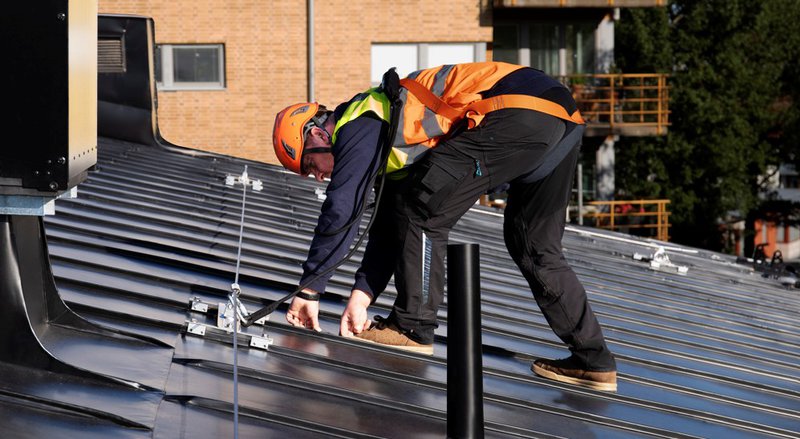
For low-slope roofs, OSHA uses distance from the edge to determine which fall protection measures are required. Workers within 6 feet of the edge need guardrails, safety nets, travel restraint or personal fall arrest systems. Between 6 and 15 feet from the edge, the same options apply, though a designated area may be used for work that is infrequent and temporary. Protection is still required at 15 feet or more, with a narrow exception for truly infrequent tasks. Facility teams can review the full breakdown of roof edge fall protection requirements to see how these zones apply to their roof layout.
Roof Edge Guardrail Rules Under OSHA Roofing Standards
Guardrail systems are the most straightforward way to protect workers near a roof edge. OSHA sets specific requirements for how they must be built and installed. The top rail must sit between 39 and 45 inches above the surface where workers stand. A midrail must run between the top rail and the surface. The system must hold up to 200 pounds of force applied at any point along the top rail.
A guardrail that looks sturdy may still fall short of these requirements. Rails installed at the wrong height, missing midrails and systems not suited to the roof surface are all common problems. When evaluating rooftop guardrail options, facility managers should look for systems designed to meet OSHA requirements while accommodating the specific conditions of their roof. For example, NextGen 3000™ Railing is a non-penetrating rooftop guardrail system designed to support compliance across a range of commercial roof surfaces and edge configurations.
Skylights and Roof Hatches: What the Rules Require
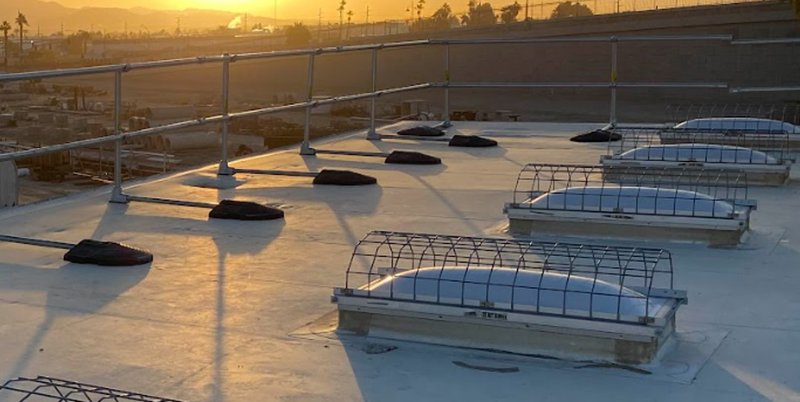
OSHA treats skylights and roof hatches as openings in the roof surface. When workers are exposed to an opening that could result in a fall of 4 feet or more to a lower level, OSHA requires fall protection. This may include a compliant cover, guardrail system, travel restraint system, or personal fall arrest system.
One common mistake is assuming a skylight dome is safe to walk near. A plastic dome is not an OSHA-compliant cover. Workers have gone through skylights that looked solid because the material was not rated to support body weight. Roof hatches need a guardrail system with toeboards whenever the hatch is open or unattended. Facility managers can review additional guidance on skylight fall protection and roof hatch safety to better understand the protection options available for these rooftop openings.
Fixed Ladders and Roof Access Requirements
Fixed ladders used to access the roof have their own set of requirements. Ladders taller than 24 feet need either a personal fall arrest system or a ladder safety system. Older ladders installed before November 2018 were also permitted to use a cage or well, but cages are no longer accepted for any ladder installed after that date.
OSHA has set a final deadline of November 2036 for all fixed ladders to have a personal fall arrest system or ladder safety system in place regardless of age. Facility managers with older ladders should inspect their current setup and plan any needed upgrades well before that deadline. You can check what compliant systems look like for existing structures in Safety Rail Source’s guide to fixed ladder fall protection.
OSHA Roofing Standards Every Facility Manager Should Review
A rooftop review does not need to be complicated. Start by listing every point where workers access the roof, then check each area against the applicable OSHA standard. Key items to check include:
- Roof edges. Confirm guardrails are in place, properly measured from the walking surface and meet the height requirement.
- Skylights. Verify each skylight has a compliant screen, cover or guardrail system. A plastic dome does not count.
- Roof hatches. Check that each hatch has a guardrail system with toeboards whenever it is open or unattended.
- Fixed ladders. Confirm each ladder used for roof access has a personal fall arrest system or ladder safety system, especially for ladders over 24 feet.
- Contractor access. Outside crews doing maintenance or inspections fall under the same standards as facility staff. Gaps in contractor coverage are a frequent source of citations.
Safety Rail Source offers OSHA code assessments to help facility teams find compliance gaps and match the right products to each area of the roof. Contact us today to review your facility's rooftop safety setup and find the right solutions for your access points, roof surface and maintenance schedule.